Manufacturing and disposing of traditional superabsorbent materials made from nonrenewable resources like petroleum affects the environment. Disposable diapers alone impact the planet’s health. The World Economic Forum reported in August 2023 that over 300,000 disposable diapers are incinerated or taken to landfills each minute.
Production of traditional superabsorbent polymers often requires significant energy inputs, which contributes to their overall environmental footprint. Also, they are made from raw materials derived from nonrenewable resources, like petroleum-based products, which also are used to make plastics and various chemicals.
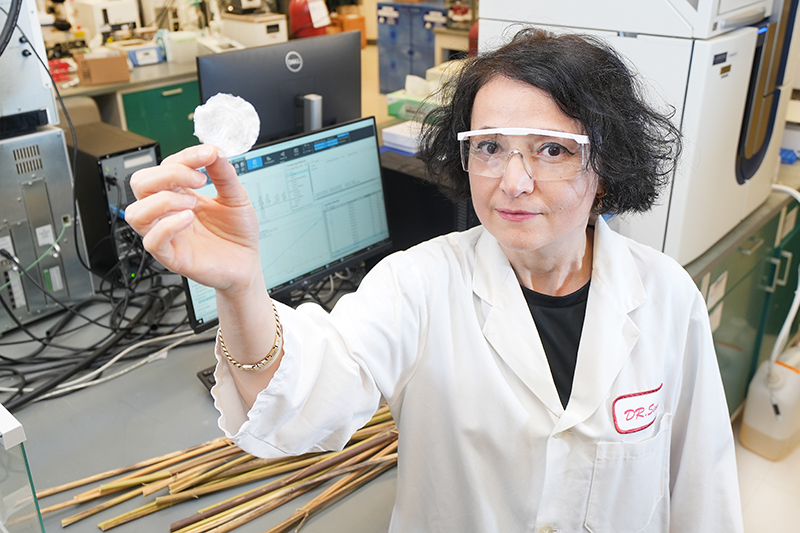
Purdue researchers are using cellulose extracted from hemp and refined through treatments to create the patent-pending, superabsorbent materials. Hemp hurds, found in the inner woody core of the hemp stalk, are highly absorbent. Hemp bast, the fibrous outer layer, while less absorbent, provides strength and durability.
The researchers tested the Purdue superabsorbent materials made using standardized absorbency tests, which compared them against traditional materials. The hemp hurd showed significantly higher absorption capacity than both hemp bast and many traditional materials.
Senay Simsek, College of Agriculture
Email: otcip@prf.org
Email: Steve Martin // sgmartin@prf.org