Purdue University innovations can be found in all 50 U.S. states and in nearly 100 countries around the world. Millions of people benefit from the cutting-edge research that takes place at Purdue, particularly in the areas of oncology therapeutics, drug delivery innovations, and MedTech innovations.
If you are interested in any of these technologies, please fill out the brief form at the bottom of this page to learn more non-confidential information on technologies available to license. Additionally, representatives from the Purdue Innovates Office of Technology Commercialization will be at Booth # 3143 at BIO for in-person conversations.
Oncology Therapeutics
Tech 1

Potent, Highly Specific TC-PTP Degrader for Treatment of Skin Cancer and Enhancement of CAR-T Therapy
Technology No. 2024-ZHAN-70394
Researchers have developed a small molecule degrader (dubbed TP1L) that is highly selective for TC-PTP, leaving all other relevant PTPs unaffected. By degrading TC-PTP through the ubiquitin proteasome pathway, TP1L allows cells to properly regulate IFN-gamma signaling, promoting anti-tumor activity. A 26% and 100% increase of CD25 and CD69 respectively, was observed after treatment with TP1L.
Watch: Purdue researchers discover new cancer-fighting compound
Tech 2
Enhanced Cell-potent Inhibitors for NTMT1/2 for Treating Cancers
Technology No. 2022-HUAN-69636
Researchers have designed a series of new peptidomimetic inhibitors for protein alpha-N-terminal methyltransferases (NTMTs). To improve the cellular inhibition activity of previously invented peptidomimetic inhibitors, researchers designed several cell-potent peptidomimetic inhibitors of N-terminal methylation which displayed not only increased cellular inhibition, but were also optimized for increased hydrophobicity which co-relates with increased cell permeability.
Tech 3
Novel Anticancer Covalent Inhibitors of SHP2 Tyrosine Phosphatase Inspired from Natural Products
Technology No. 2023-DAI-70254
Researchers at Purdue have developed a novel library of natural-product inspired covalent inhibitors of SHP2 tyrosine phosphatase. After testing the inhibitory activity of their natural-product inspired drug library with SHP2, they discovered a series of molecules that have from a 6 to 119-fold increase in inhibitory activity as compared to previously reported SHP2 covalent inhibitor phenyl vinyl sulfonate.
Featured startup: LigamiR Therapeutics
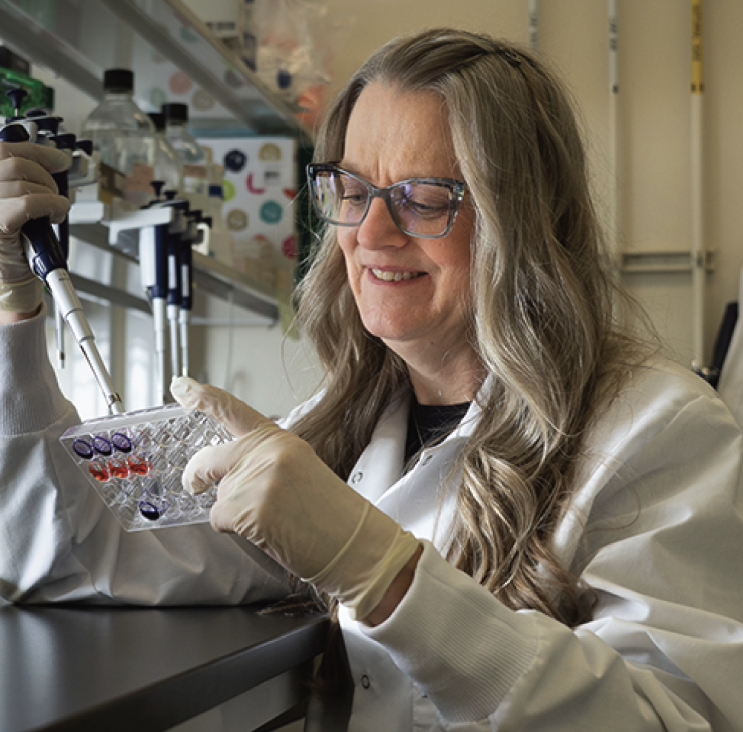
Purdue University researcher Andrea Kasinski is developing microRNA-34a in the lab and through LigamiR Therapeutics, a company she founded to advance RNA therapeutics. The startup uses Purdue technology to advance innovation:
“A Chemically Modified MicroRNA as an Anticancer Agent” (70078, Andrea Kasinski)
Drug Delivery Innovations
Tech 1
Nanopuff: A New Class RNA Therapeutic Carrier
Technology No. 2023-YEO-70458
This technology helps deliver RNA therapeutics to target cells via systemic administration to treat cancers, infectious diseases, and neurological disorders. The technology alleviates safety concerns attributed to traditional cationic carriers and protects RNA from its harsh physiological environment. Nanopuff also enhances cellular uptake and avoids toxicity.
Tech 2
RNA Lipid Nanoparticles for Pharmaceutical Uses
Technology No. 2025-ZHOU-71178
With this novel method and composition, researchers have developed a way of producing mRNA-LNPs with enhanced stability and a flowable, dispersible consistency that makes it suitable for inhalation directly into the lungs. In addition, this method saves time and energy compared to standard pharmaceutical drying procedures such as lyophilization.
Tech 3
Delivery of Nucleic Acids Using a Targeted Peptide Carrier System (70252)
Inventor: David Thompson
Read more: Purdue mRNA therapy delivery system proves to be shelf-stable, storable
MedTech Innovations
Tech 1
Microneedle Patch for Wound Oxygenation and Biofilm Eradication
Technology No. 2021-RAHI-69535
Researchers have developed a flexible microneedle array on a polyethylene terephthalate (PET) support that can puncture biofilms and provide oxygen and antibiotics to the wound site. The microneedle array developed by Purdue researchers dissolves upon contact with the wound’s biological fluid, is effective for decontamination and increasing the healing process of wounds, and is also nontoxic.
Tech 2
Vascularized Neuroimmune Organoids with Patient Brain Homogenates for Alzheimer’s Research and Drug Discovery
Technology No. 2024-XU-70690
Researchers have developed a human pluripotent stem cell (hPSC)-based vascularized neuroimmune organoid model for Alzheimer’s Disease (AD) modeling and drug discovery. The new organoid model can be used for testing AD therapeutics, particularly antibody-based therapeutics, and studying AD disease mechanisms.
Featured startup: Emboa Medical

The medical device startup has created a novel microstructured catheter that has been validated to improve outcomes for stroke patients. Its patent-pending platform, called TRAP, or thrombus retrieval aspiration platform, emulates a boa constrictor’s teeth arrangement in its biomimetic design to grab onto blood clots without tearing them.
Emboa uses multiple Purdue technologies to advance innovation, including:
- Novel Thrombectomy Catheter with Biomimetic Microteeth Array (70115)
- High-Throughput Magnetic Actuation Platform for Cancer Treatment Screening (68700)
- In Plane Cell Stretching with Force Characterization and Optical Capabilities (70351)
Industry partners interested in developing or commercializing any of these technologies should contact Clayton Houck, senior licensing associate, life sciences, through this form.
"*" indicates required fields