Purdue's semiconductor innovation comes from cutting-edge research, strategic partnerships, and excellence at scale.
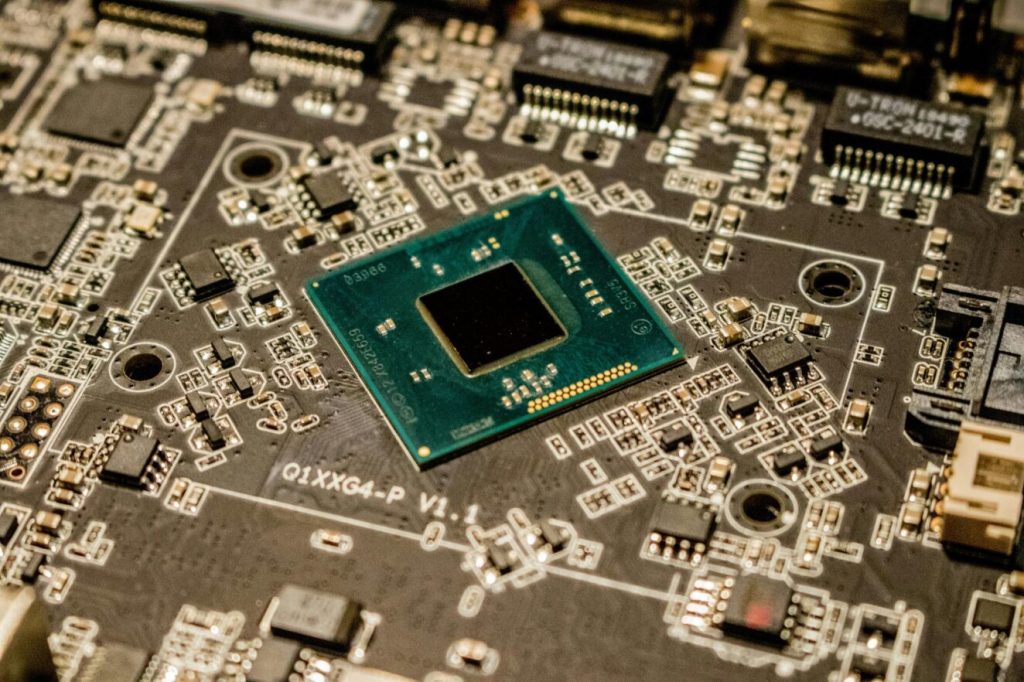
It seems impossible that something so small could be the engine of modern technology, but that’s exactly the incongruity of semiconductors. These delicate electrical components, which you’ve likely encountered dozens of times today alone, are so small they’re measured in billionths of a meter.
In plain English: they’re incredibly small and incredibly important.
Make no mistake: semiconductors are a big deal. Purdue University recognizes that.
As Ian Steff, president and CEO of mySilicon Compass and former assistant secretary of the U.S. Department of Commerce, said at the 2023 CHIPS for America Summit in Washington, D.C.: “I have no doubt that the university that equipped the first and last man to walk on the moon to date will rise to help meet the national challenge before us – gathered here to research, design, fabricate, and package the semiconductors that will carry the next generation of celestial explorers to the moon and beyond.”
They may be mysterious to many of us, but semiconductors are critically important in a wide range of applications from going into orbit down to the phone in your hand. Because of this, the U.S. has recognized the strategic importance of investing in semiconductor research and development to secure and maintain its economic strength.
Without major, home-grown expansion, the U.S. remains vulnerable to long global supply chains and other geopolitical tensions. That’s why the recent U.S. CHIPS for America Act provides $52 billion in grants for semiconductor manufacturing and research.
When President Biden signed the bipartisan CHIPS and Science Act, he put a stake in the ground and sent a signal to the world that the United States cares about semiconductor manufacturing,” said Arati Prabhakar, President Biden’s chief science and technology advisor and director of the White House Office of Science and Technology Policy. “Today’s announcement [SK hynix’s investment in West Lafayette] will strengthen the economy and national security, and it will create good jobs that support families. This is how we do big things in America.
But we’re getting ahead of ourselves; first, what are semiconductors and how are they used?
Mark Lundstrom is the Don and Carol Scifres Distinguished Professor of Electrical and Computer Engineering and the chief semiconductor officer at Purdue University. He explains why establishing chip manufacturing in the United States is important and the challenges that face the industry, universities and the government.
What are semiconductors?
At their most basic, semiconductors are high-tech gates. They use materials that have electrical conductivity between that of a conductor and an insulator, allowing them to conduct electricity under some circumstances but not all.
These special electrical properties mean semiconductors serve as the foundation for a range of electronic devices. The most foundational for everyday life are our modern electronics. The phone or computer you’re reading this on uses semiconductors. Digital cameras, cars, televisions, washing machines, LED bulbs… all use semiconductors.
But that’s not why U.S. policymakers are laser-focused on building semiconductor supply chain resilience. Beyond the every day, semiconductors are critical to national security functions. Computing, defense systems and all communications infrastructure rely on secure semiconductors to work.
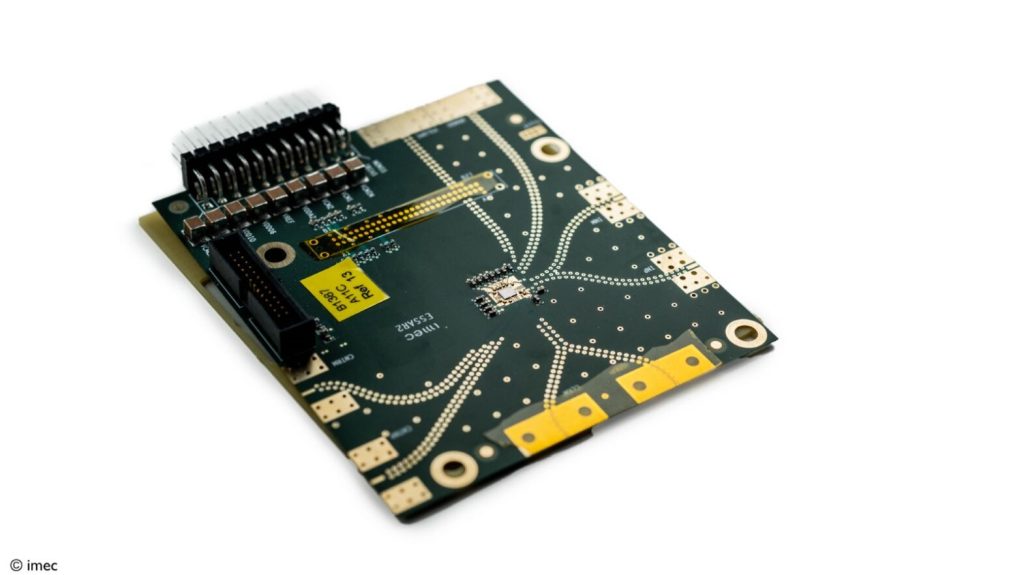
Bringing imec, a renowned R&D and innovation hub in nanoelectronics and digital technologies, to the Convergence Center in Discovery Park District at Purdue brings hope that future needs can be met by domestic semiconductor production.
Unfortunately, we’re not there yet.
An industry ripe for disruption
You may have heard of the automobile ‘chip shortages’ during COVID. In large part it was due to China’s lockdowns coinciding a massive spike in demand for consumer electronics.
The truth is the industry isn’t yet set up to meet burgeoning demand – but collaborations between Purdue and industry innovators up and down the Hard Tech Corridor make Greater Lafayette a prime location for semiconductor R&D.
As U.S. Secretary of State Antony Blinken noted, “Why is someone from the State Department, dealing with America’s foreign policy and our role in the world, coming to Purdue, looking to speak with incredible people that are focused on STEM? … it became more and more apparent to me that so much of what we were working on, so many of the problems that we were trying to solve, actually had a profound connection to science, technology, and innovation.”
What better place to solve these complex problems than in a city along the Wabash River, forged by discovery and built by innovation?
Highly specialized work with a big employment gap
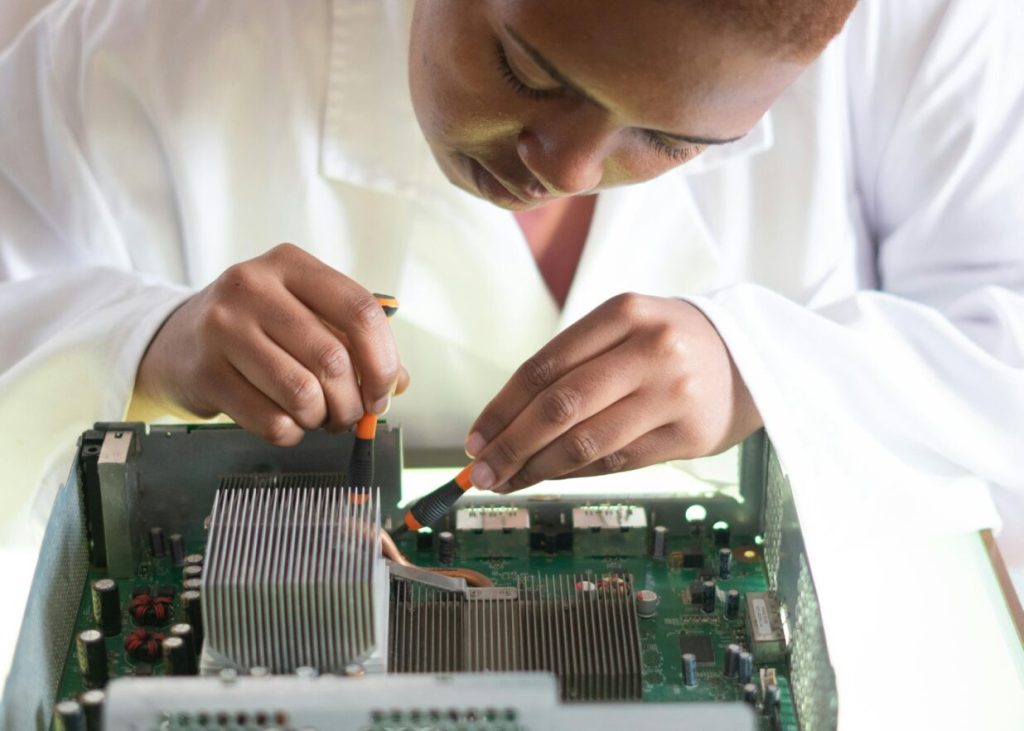
Unsurprising for something so delicate, this is highly specialized work and Purdue semiconductor programs are tasked with meeting that challenge.
Imagine: a facility that’s capable of quickly and carefully imprinting electronic circuits on wafers of silicon – all on a nanometer scale.
Building or even expanding current fabs (industry shortform for “fabrication facility”) takes considerable time and investment because of the sensitive manufacturing processes. It’s very costly and time-consuming to increase production and often takes a year for significant expansion or more than three years to build a new facility.
But even if companies could scale up at speed, they’d still contend with a pernicious lack of skilled workers. “In the United States, official estimates suggest that companies across industries will face a shortfall of 300,000 engineers and 90,000 skilled technicians by 2030,” noted a McKinsey & Company report.
Purdue has big plans to address both shortfalls.
“These semiconductor products are the foundation of our national security, economic security, and job security across many digital economy industries. After tens of billions of tax dollars and hundreds of billions of private sector investments are announced, one wonders, where do you find the workforce? By one estimate, we’re going to need 50,000 more semiconductor-related engineers in our country this decade alone.”
In 2022, the university launched the nation’s first program for semiconductor degrees. These efforts are further expanded with $19M in funding from the U.S. Department of Defense to strengthen existing efforts in key research areas and to add new academic partners. Purdue has also been recognized by Fast Company as one of the World’s Most Innovative Companies for its advances in workforce development in semiconductors and microelectronics.
“Purdue’s cutting-edge research and workforce development programs are at the forefront of helping us shape the future of innovation in America’s semiconductor manufacturing industry. I’m excited to learn about the workforce pipelines Purdue is creating, including opportunities at all levels of the industry,” said Gina Raimondo, U.S. secretary of commerce.
Purdue can’t tackle such a sprawling alone. A Purdue partnership with Ivy Tech will provide a variety of collaborative educational opportunities for faculty and students in microelectronics and will explore ways to attract more talent to this area. Additional agreements with industry leaders like imec reflect additional investments in microelectronics industry research and semiconductor workforce development to meet this critical need.
SK hynix announces semiconductor advanced packaging investment in Purdue Research Park
SK hynix Inc. announced Wednesday (April 3) that it plans to invest close to $4 billion to build an advanced packaging fabrication and R&D facility for AI products in the Purdue Research Park. The development of a critical link in the U.S. semiconductor supply chain in West Lafayette marks a giant leap forward in the industry and the state.
One additional wrinkle is simply that global supply chains are tenuous. Lockdowns and other regional instability revealed that semiconductor production and distribution is easy to disrupt. Because of semiconductors’ highly concentrated production spots, mostly in Asia, the U.S. is dependent on faraway producers to meet their needs and is unable to be agile in the face of massive spikes in demand.
However, it wasn’t always like this. In 1990, the U.S. produced about 40% of all semiconductors in the world (now it’s something closer to 5%). The partnerships between Purdue, the state of Indiana and semiconductor research companies like imec aim to regain some of that market share.
These strategic partnerships are laser-focused on mitigating supply chain disruptions and advancing the state’s high-tech workforce development. With imec and IEDC’s investment, researchers from the global R&D technology company will work side by side with faculty and students at the Birck Nanotechnology Center, located in the district. Similarly, students and faculty will have an opportunity to work in Belgium.
It’s just one more piece in Purdue’s semiconductor innovation ecosystem that seeks to solve the puzzle of growth, innovation and retaining skilled workers in Indiana.
Looking to the future of semiconductors
Bringing manufacturing home is a key part of ensuring the current issues around semiconductor manufacturing doesn’t become a larger problem.
Purdue’s constant striving to bring manufacturing closer to home wouldn’t be possible without strategic partnerships between so many different parties. The university’s collaborative, innovative approach is getting noticed – something sure to help as momentum builds toward domestic semiconductor creation.
As Blinken noted: “Purdue University has got to be one of the leading, if not the leading, human fabs for the next generation of people who are going to lead this country, into the technological future, into the scientific future, and into the innovative future.”