3 patent-pending innovations address issues of privacy, false alarms, self-calibration and affordability
HAMMOND, Ind. — Wei Dai, assistant professor of computer science and director of the Advanced Intelligence Software Lab at Purdue University Northwest, leads a team that has leveraged artificial intelligence to improve upon traditional methods to detect gunshots fired during active shooter scenarios and notify emergency responders.
The technologies may improve safety on school campuses and other public areas by enhancing situational awareness and reducing law enforcement and public safety officers’ response time to incidents involving gun violence.
Dai said traditional indoor gunshot detection systems have four drawbacks: minimal privacy protection due to using cameras for visual detection, a high number of false alarms, limited or no self-calibration, and low affordability.
“When talking about gunshot detection in schools, faculty are interested in privacy protections,” he said. “Campus police are concerned about false alarms that can divert emergency responders from actual emergencies and delay their response to real crises.”
Dai has developed three technologies to address the drawbacks:
- The first is a physical sensor design that detects gunshot sounds with privacy protection.
- The second uses AI to identify gunshots while minimizing false alarms.
- The third provides the ability for self-calibrating/self-testing systems.
Dai said the system also addresses affordability issues.
“Our entry-level system can identify gunshots in a four-story building for less than $500 of hardware, including acoustic sensors, a mini-PC and microphone cables,” he said. “Because it leverages algorithms and AI, it doesn’t require specially designed microchips.”
The system also monitors air quality and smoking fires.
Dai disclosed these technologies to the Purdue Innovates Office of Technology Commercialization, which has applied for patents on all three to protect the intellectual property. Industry partners interested in developing or commercializing them should contact Aaron Taggart, business development and licensing manager – physical sciences, at adtaggart@prf.org about track codes 70843, 70881 and 71082.
Sensor technology
Dai’s first technology utilizes air quality sensors to detect an increase in air particles following a gunshot.
“Shockwaves from ballistic impacts and muzzle blasts create pressure waves in the air,” he said. “Air quality sensors observe movement in the particles caused by shockwaves inside its container.”
In experimental testing, the sensor detected an increase in the number of 10-micron particles after a bullet was fired from 141 feet.
Dai’s technology can be combined with other gunshot detection systems, including acoustic sensors, camera sensors and infrared sensors, to reduce false alarms.
“It is a novel idea to detect gunshots without any concerns of privacy,” he said. “Users can install air quality sensors in any room. They could monitor the air quality of buildings as well as the shockwave of gunshots.”
Dai also said unlike existing solutions, this innovation does not breach privacy because it does not use cameras for visual detection.
“Law enforcement and private security firms could use it to detect gunshots as well as unexpected, dangerous air particles or chemical air in privacy-sensitive rooms and buildings,” he said.
Leveraging AI for high accuracy
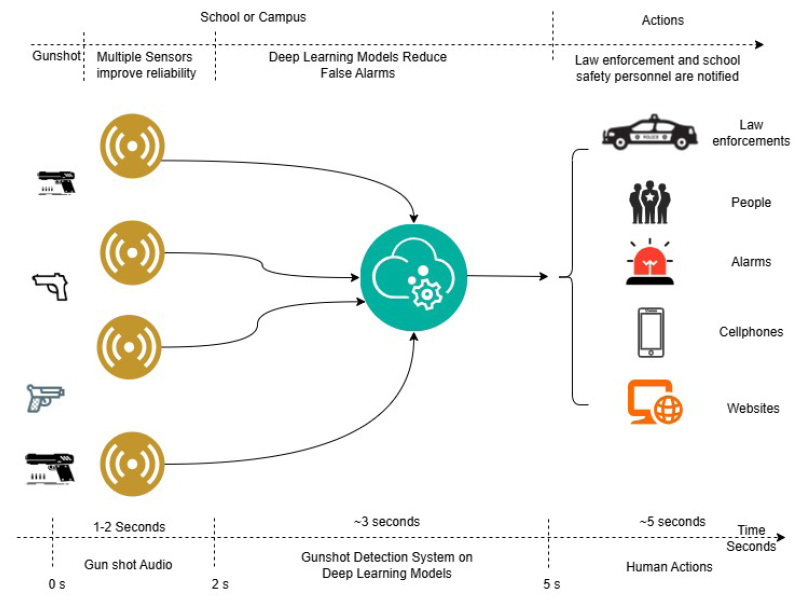
Dai’s second technology uses AI to combine gunshot detection and fire alarm solutions. He said it identifies gunshots with high accuracy by using new deep-learning models trained with microphone sensors and air quality sensors. It runs on edge computers and server-based algorithms.
“It does not require line-of-sight distance or supplementary lighting,” he said. “This improves sensor accuracy by detecting gunshots in occluded spaces and reduces privacy risks, as it does not rely on additional cameras.”
Edge computers have the potential to expand this system to other compatible devices in schools through an IoT system. The server-based programs monitor gunshot and air quality databases to detect gunshot events and fire alarms with high accuracy and low false alarms.
Self-calibrating and self-testing
Dai’s third technology is self-evaluating algorithms for calibrating gunshot detection systems. Traditional self-testing solutions are evaluated on acoustic gunshot sounds through powerful speakers or real gunshot tests. Dai said the sounds may trigger panic or unexpected mental pressure.
“This new innovation uses audio coding algorithms for testing one or multiple acoustic sensors without interrupting other people and routine operations,” he said. “For example, users may evaluate acoustic gunshot sensors in hospitals or airports during business hours.”
Dai said evaluating sensors to ensure they function perfectly is critical to saving lives.
“This self-evaluating innovation is encoding encrypted audio sounds,” he said. “It will not impact most people and regular business operations. It allows users to evaluate acoustic gunshot sensors at any time and in any location.”
During experimental testing, Dai’s team tested the audio coding algorithms in classroom hallways during business hours for two weeks. He said most students and faculty did not notice the tests.
Validation and next development steps
Purdue University Northwest has been installing and testing sensors in university facilities since January 2024. The AI-driven gunshot detection system collected 3,631 sounds similar to gunshots, with no false alarms. The research team also tested blank ammunition in 2024-25. The system can send alarm messages to police officers via mobile app or website.
Dai and his team also evaluated the number of false alarm sounds in sound simulations and field tests. These sounds include nail guns, hammers and other construction sounds, thunder, firecrackers, backfiring cars, helicopters and popping balloons.
“After testing more than 220,000 sound events, our gunshot detection system did not trigger one false alarm,” he said, “We have run the real-world tests since January 2024. As of July 31, 2025, we have collected 3,631 gunshot-likelihood sounds from our acoustic sensors, including sounds of door slams, nail guns, elevator doors, hammers and metal hits. They also do not trigger false alarms.”
Dai and his team are now conducting large-scale tests.
Acoustic environments impact the gunshot detection systems. “We are partnering with several American universities, including Indiana State University, to evaluate the gunshot detection technologies for campus use. Scientists in Greece and Japan believe that the technologies could detect gunshots or explosions at subway stations,” he said. ”We are looking for other colleges and schools to join the large-scale tests.”
Dai has received funding from Purdue University Northwest, Purdue Research Foundation and the NASA-controlled Indiana Space Grant Consortium to support the research, experimental tests and evaluations, and patent applications.
About Purdue Innovates Office of Technology Commercialization
The Purdue Innovates Office of Technology Commercialization operates one of the most comprehensive technology transfer programs among leading research universities in the U.S. Services provided by this office support the economic development initiatives of Purdue University and benefit the university’s academic activities through commercializing, licensing and protecting Purdue intellectual property. In fiscal year 2024, the office reported 145 deals finalized with 224 technologies signed, 466 invention disclosures received, and 290 U.S. and international patents received. The office is managed by the Purdue Research Foundation, a private, nonprofit foundation created to advance the mission of Purdue University. Contact otcip@prf.org for more information.
About Purdue University Northwest
Purdue University Northwest (PNW) is a student-centered university that transforms lives through innovative education, impactful research and community engagement. Located in Northwest Indiana, near Chicago, PNW is recognized as a First Scholars institution and an Innovation and Economic Prosperity University. PNW advances the socioeconomic mobility of its students and positively impacts regional development. For more information, visit pnw.edu.
About Purdue University
Purdue University is a public research university leading with excellence at scale. Ranked among top 10 public universities in the United States, Purdue discovers, disseminates and deploys knowledge with a quality and at a scale second to none. More than 107,000 students study at Purdue across multiple campuses, locations and modalities, including more than 58,000 at our main campus in West Lafayette and Indianapolis. Committed to affordability and accessibility, Purdue’s main campus has frozen tuition 14 years in a row. See how Purdue never stops in the persistent pursuit of the next giant leap — including its comprehensive urban expansion, the Mitch Daniels School of Business, Purdue Computes and the One Health initiative — at https://www.purdue.edu/president/strategic-initiatives.
Media contact: Steve Martin, sgmartin@prf.org