Purdue researchers persistently pursue innovations and breakthroughs that help move the world forward. Explore recent inventions brought into the world by Boilermakers and just what it takes to bring an idea from the lab bench to commercialization.





A Rail-Rung System for Installation of a 3-phase Dynamic Wireless Power Transfer Transmitter in a Roadway
People: Steven D. Pekarek (project leader), Dionysios Aliprantis, Aaron D. Brovont, and Robert R. Swanson.
This Purdue technology would enable highway pavement to provide power to EVs similarly to how newer smartphones use magnetic fields to wirelessly charge when placed on a pad.
People: Letian Dou (project leader), Sung-Doo Baek, and Wenhao Shao.
Applicable within the semiconductor industry, biomedical applications, night vision, or LIDAR, researchers at Purdue University have developed a near-infrared (NIR) perovskite light emitting diode (PeLED) with exceptional brightness and efficiency.
People: Dustin Cruise (project leader) and Galen B. King.
Flames change shape by the millisecond, affecting its heat release and stability. Purdue researchers have created methods to dynamically manipulate a flame using electric fields and electrode configurations to control its heat release.
People: Yangyuan Ji (project leader), Youn Jeong Choi, Yuhang Fang, Linda S. Lee, Junfeng Niu, Alliyan Tan Nou, Hoang Son Pham, and David Elan Martin Warsinger.
PFAS, known as “forever chemicals”, poses a significant risk to the environment and human health even at low levels. Purdue University researchers have developed an electric field-assisted nanofiltration approach. Testing of the approach demonstrated the ability to remove and destroy 97% of perfluorooctanoic acid (PFOA), a common PFAS.
People: Rakesh Agrawal (project leader), Akash Sanjay Nogaja, and Mohit Tawarmalani.
Adoption of heat pumps and heat recuperation is recognized as a pivotal technology for decarbonization but has drawbacks. Researchers at Purdue University have developed a heat pumped distillation system that enables the coproduction of steam to repurpose waste heat, increasing energy efficiency.
People: Steven F. Son (project leader) and Caleb Nathaniel Harper
With applications in energetic materials like explosives and pyrotechnics, these aluminum alloys with improved ignition and combustion properties for energetic materials applications.

Learn More
People: Richard J. Kuhn (project leader), Steven K. H. Foung, Zhen-yong Keck, and Devika Sirohi.
HCV causes 1.5 million new infections each year globally and is the leading cause for liver transplantations in the U.S. e. Leveraging the power of mRNA vaccinology with engineered HCV antigens, Purdue University researchers have taken a critical step towards the development of an efficacious HCV vaccine.
People: Pengyi Shi (project leader) and Jonathan Helm.
Researchers at Purdue University and Indiana University have developed an analytics solutions system to address widespread nurse deployment and staffing issues. This solutions system helps large hospital networks tackle widespread nursing shortages by offering integrated, end-to-end solutions to streamline nurse deployment.
People: Quihong He (project leader), Lindsay R. Brncick, Julia L. Flowers, and Boxi R. Gong.
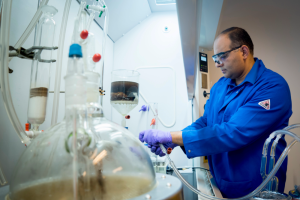
This strain developed by Purdue researchers helps oncologists and pharmaceutical companies effectively treat immunologically cold solid tumors by inducing host innate and adaptive immune responses to enhance cancer immunotherapy.
People: Herman O. Sintim (project leader) and Desmond Akwata
Multiple myeloma, a blood cancer, is characterized by dysregulated and proliferative plasma cells, which facilitate bone destruction. Researchers at Purdue University have developed a novel transforming growth factor-beta activated kinase 1 (TAK1) inhibitor therapeutic for multiple myeloma.
People: Yoon Yeo (project leader) and Woojin Kim
Researchers at Purdue University have developed an effective carrier system for RNA drugs which helps deliver RNA therapeutics to target cells via systemic administration to treat cancers, infectious diseases, and neurological disorders.
People: Junli Liu (project leader) and Nathan Scott Mosier
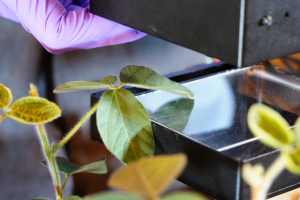
Currently, almost all lubricants are produced from petroleum, which are not readily biodegradable and often have toxic additives included. Researchers have discovered a method to produce biodegradable lubricants from common agricultural byproducts.
People: Xiulin Ruan (project leader) and Abdulrahman Aljwirah.
This silicone rubber coating for radiative cooling applications developed by Purdue University researchers differentiates itself from existing competition by utilizing highly reflective and non-UV absorbing material to cool, protect, and preserve structures from excessive heat.