September is Prostate Cancer Awareness Month. We are sharing stories of Purdue University researchers and companies that have created diagnostics and therapies to help people with the disease.
Facts about prostate cancer
Before we share information about a Purdue University innovation that could predict a relapse of prostate cancer, let’s look at prostate cancer and its impact.
- In its Cancer Facts & Figures 2023 report, the American Cancer Society estimates that more than 288,000 new cases of prostate cancer will be diagnosed in the United States in 2023.
- It estimates more than 34,000 American men will die from prostate cancer in 2023.
- Early-stage prostate cancer usually shows no symptoms. The 5-year survival rate of men with distant-stage disease is 32%.
- The American College of Surgeons reports prostate cancer is the second-most common cancer among men.
- One is 9 men will be diagnosed with prostate cancer in their lifetime.
- Prostate cancer is the number two cause of death among men.
Prediction innovation
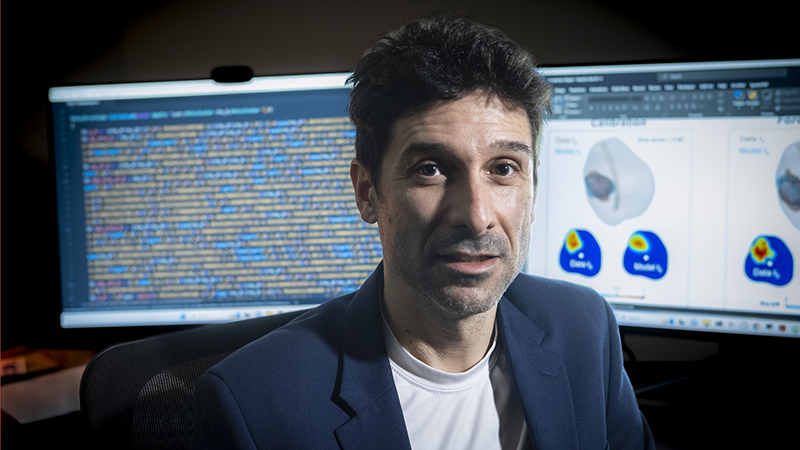
Hector Gomez, a professor in Purdue University’s School of Mechanical Engineering, has developed a method and algorithm to predict the relapse of prostate cancer in patents treated by radiation therapy.
Gomez said more than 60,000 American men opt for radiation therapy every year to treat their prostate cancer. The detection of prostate cancer recurrence after radiation relies on the measurement of a sustained rise of the serum levels of a substance called PSA. However, the relapse may take years to occur, which delays the delivery of a secondary treatment to patients with recurring tumors.
“To address this issue, we have developed novel, patient-specific forecasts of PSA dynamics to predict cancer relapse,” Gomez said. “Data indicates that our model-based predictors of relapse can identify relapsing patients a median of 14.8 months earlier than the current clinical practice, thus providing an opportunity to quickly deliver a secondary treatment.”
Gomez disclosed the innovation to the Purdue Innovates Office of Technology Commercialization, which has applied for a patent from the U.S. Patent and Trademark Office to protect the intellectual property.
“Developing an algorithm to predict prostate cancer relapse in radiation therapy patients is incredibly rewarding,” Gomez said. “The satisfaction comes from knowing that your work has the potential to make a significant positive impact on numerous individuals.”
Gomez’s collaborators include international researchers at the University of Pavia in Italy and the University of Castilla–La Mancha in Spain. Their research has been published online.
The Purdue Institute for Cancer Research
Hector Gomez is among the Purdue University faculty whose work is supported by the Purdue Institute for Cancer Research.
“There is an important need for prognostic technology like Hector’s to be further developed to begin to predict which prostate cancer patients are at high-risk so they can be followed more closely and monitored to verify the recurrence,” said Timothy Ratliff, former director of the Purdue Institute for Cancer Research and Distinguished professor of comparative pathobiology in the College of Veterinary Medicine. “I am proud that Purdue University has outstanding organizations like the Institute for Cancer Research that bring together faculty to generate new technologies that impact people’s lives.”