Printing 3D parts with customized shapes and sensor properties in a single step
April 17, 2023
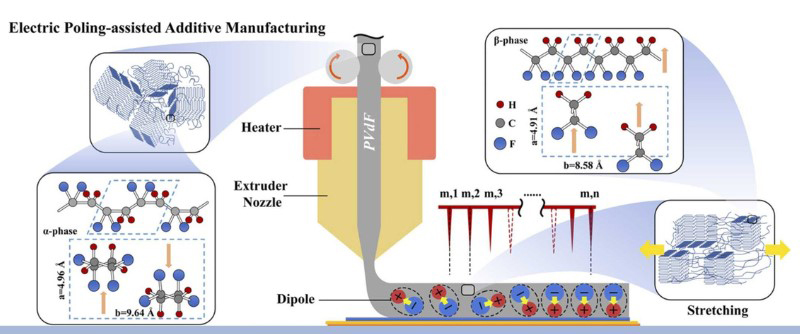
A new technique has been devised by Purdue scientists that integrates electric poling and 3D printing in a single process. This enables the creation of 3D-printed components with tailored shapes and robust sensing capabilities, while also saving both time and money.
Parag Vasekar
Business Development and Licensing Manager – Physical Sciences
PROBLEM
3D printing, also known as additive manufacturing, has several advantages over traditional manufacturing, including customizing parts’ shapes and geometries. However, the filament used in 3D printing isn’t suitable to create sensors. As a result, an additional process must be conducted to make 3D printed parts suitable to serve as sensors, which increases manufacturing time and cost.
SOLUTION Purdue researchers have combined 3D printing and electric poling into a single process called electric poling-assisted additive manufacturing, or EPAM. It aligns the dipoles in the filament during the print, which allows 3D-printed parts to have both strong sensing abilities and customized shapes. Importantly, it saves time and money.