The Purdue researchers demonstrated two significant advances with their work – successfully fabricating synapses capable of volatile (short-term) and non-volatile (long-term) memory and image recognition.
Jacob Brejcha
Licensing Associate – Physical Sciences
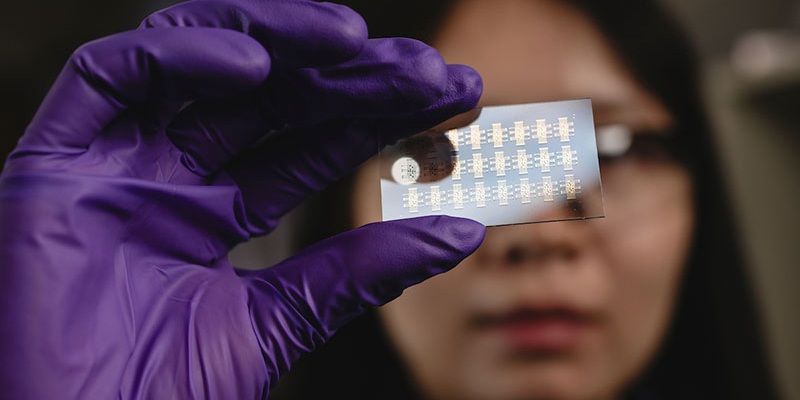
Ke Chen at Purdue University displays a device for computer vision that mimics how retinal cells perceive light. (Purdue University photo/ Charles Jischke)
PROBLEM In traditional computer vision systems, signals are created and the data is transferred from memory to processing and back to memory. The process takes a lot of time and energy.
SOLUTION Purdue University researchers are creating a computer vision system that mimics the human retina in terms of light perception, making it potentially much less data intensive than traditional systems. Their device has integrated functions of light perception, light-to-electric-signal transformation, and on-site memory and data processing.
PRIMARY INVESTIGATOR Jianguo Mei, College of Science