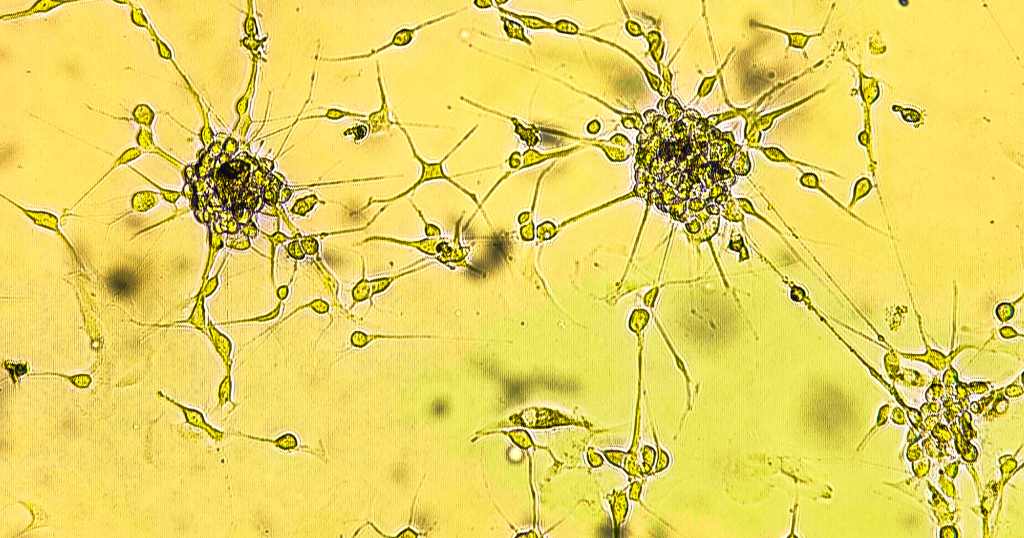
Organoids are 3D cell structures derived from human stem cells. They model organs so researchers can study growth and development. They also show how the body responds to pharmaceuticals, enhancing drug discovery. Purdue University researchers have improved the speed to prepare organoids, have created a new organoid model for Alzheimer’s disease, and have developed an array that allows for easier culturing of organoids.
solution 1
RAPID PREPARATION OF ORGANOIDS
Researchers have developed a patented hydrogel printing method for the fast, robust preparation of organoids. Current methods lack reproducibility and robustness. To address these drawbacks, the Purdue researchers fabricated organoids by loading hydrogel drops with different cell lines and strengtheners.
After being printed, the cells achieve spheroid sizes of ~500 micrometers in less than a day. This reproducible, rapid-processing technique can serve as a new standardized protocol to address current limitations in spheroid/organoid generation.
solution 2
ORGANOID TO MODEL ALZHEIMER’S DISEASE
Researchers have developed a patent-pending organoid model for Alzheimer’s disease (AD) modeling and drug discovery.AD affects more than 55 million people around the world and available treatments are severely lacking. Also, current models mainly focus on inherited familial AD; there are scarce models for its counterpart, sporadic AD, even though 95% of AD cases do not have gene mutations.
The Purdue model incorporates multiple cell types affected in human AD brains including neurons, microglia, astrocytes and blood vessels. The new organoids can be used to test therapeutics, especially antibody-based therapeutics, and to study disease mechanisms.
solution 3
COLLAPSIBLE SPHEROID BASKET ARRAY
Researchers have developed a 96-well Collapsible Basket Array (CBA) for high-throughput culture and histological analysis of tumor organoids. It eliminates manual transferring of organoids into deep histology cassettes. To process organoids in a laboratory environment, they must be transferred from 96-well plates in an 8×12 array into a deep histology cassette. The only transfer method is manual transferring, which is tedious and labor-intensive.
The Purdue 96-well CBA is designed to transfer organoids cultured in a standard 96-well plate into a deep histology cassette. It maintains the original 8×12 array registry so that organoids can be processed, paraffin-embedded, and sectioned as the 8×12 spheroid microarray.
Industry partners interested in developing or commercializing the innovations should contact Clayton Houck, Senior Licensing Associate – Life Sciences, cjhouck@prf.org.