Purdue Innovates and three Purdue University colleges have announced four recipients of a Commercialization Fellowship. The fellowship provides recent Ph.D. graduates and postdoctoral researchers an opportunity to advance the commercialization of Purdue-owned intellectual property.
Alongside faculty inventors, each fellow will work towards a ready-to-license technology or a defined pathway to a startup company. Their work is based on intellectual property already disclosed to the Purdue Innovates Office of Technology Commercialization, which operates one of the most comprehensive technology transfer programs among leading research universities in the U.S.

Learn more about the fellows turning research into real-world impact in 2025:
Inventor: Xiulin Ruan
Andrea Felicelli
Andrea Felicelli sees a world of possibilities emerging from her work developing cooling technology and paints that can cool the surfaces of cars, buildings, airplanes and more without any electrical inputs. These Purdue technologies can keep critical infrastructure cool as global temperatures rise, reducing carbon emissions and environmental impact. Her fellowship will focus on their patented lightweight formulation which has far-reaching impacts for strategic partners across a variety of industries.
Related story: World’s whitest paint now thinner than ever, ideal for vehicles

I see so much potential for the technology, and I wholeheartedly believe in its potential. Thanks to this fellowship, I hope to see this work leave the lab and get into the real world to solve real world problems.
Andrea Felicelli
Purdue University College of Engineering
Inventor: Arezoo Ardekani
Andres Barrio-Zhang
Andres Barrio-Zhang’s research focuses on nanoparticles, tiny particles of matter that are 1–100 nanometers in diameter. (For context, human hair is approximately 80,000–100,000 nanometers wide.) Nanotechnology uses these nanoparticles with major applications in medicine and biology, including the development of mRNA vaccines.
During his PhD, Barrio-Zhang designed and developed a new microscope which allows researchers to more thoroughly differentiate and identify specific nanoparticles, giving better information about the materials being analyzed. By enhancing standard microscopy techniques, researchers will gain greater understanding of these vital components and accelerate research critical to innovation.

I think that when you enter the marketplace, that’s when you truly start seeing the widespread impact of your work. I’m excited to participate in this fellowship and explore how to support high-risk, high-reward technologies that need help in transitioning out of the lab.
Andres Barrio-Zhang
Purdue University College of Engineering
Inventor: Senay Simsek
Divya Kamireddi
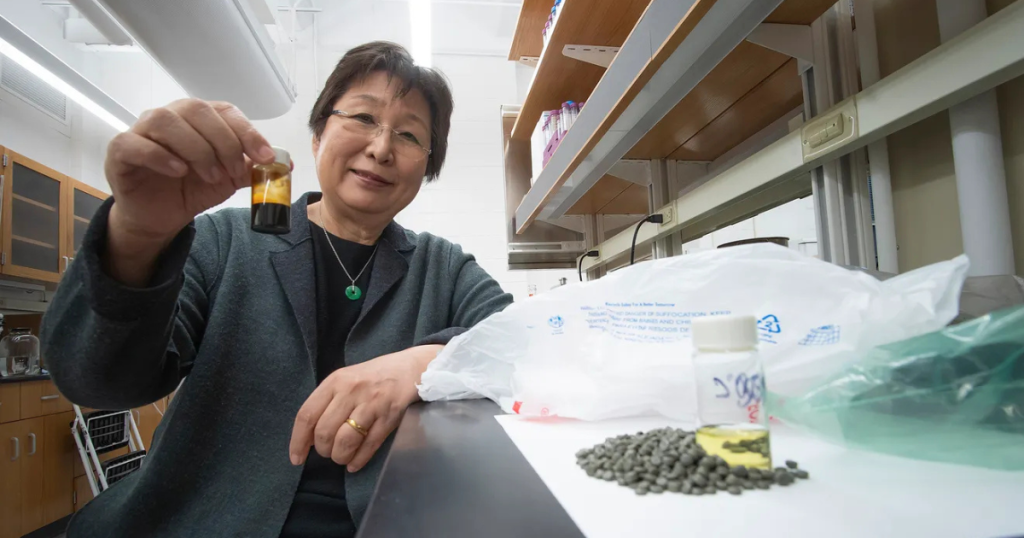
Researchers in the College of Agriculture are developing superabsorbent materials with a much lower environmental impact than current alternatives made from nonrenewable resources. Fellow Divya Kamireddi will work with hemp fibers to extract cellulose using a special process to create the patent-pending, superabsorbent materials. While Kamireddi’s main focus is developing a product for soil retention, the eco-friendly hemp material could also be used across industries from diapers and feminine products to food storage to biomedical applications and beyond.
Related story: Purdue researchers develop sustainable, biodegradable superabsorbent materials from hemp

It’s very important for me that research not just stay in the lab. The superabsorbent polymers we’re developing would not be possible without all of the core science research that has been done over the decade, but what matters to me personally is to ensure that any research I contribute to has tangible, real-world impact.
Divya Kamireddi
Purdue University College of Agriculture
Inventor: Eric Munson
Nick Huls
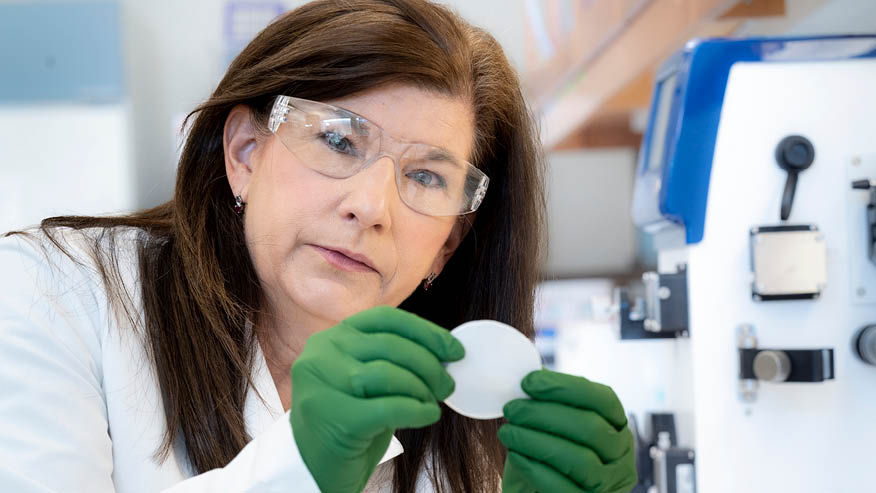
Fellow Nick Huls will spend his fellowship commercializing a technology that he and Munson have developed as a quality control measurement for freeze-dried products with a focus on the medical field. Current testing methods are imprecise or require opening a vial, rendering it ineffective. Both can cost companies big money, as vials can be worth thousands of dollars each. Purdue’s innovative technology measures the mobility of freeze-dried components and allows for the analysis of material while still in the vial, reducing waste and saving money.

Nick Huls
Purdue University College of Pharmacy
Media contact: Polly Barks, phbarks@prf.org