
Low is Purdue’s Presidential Scholar for Drug Discovery, the Ralph C. Corley Distinguished Professor of Chemistry in the College of Science, and a faculty member in the Purdue Institute for Cancer Research and Purdue Institute for Drug Discovery. He has spent many years working closely with the Purdue Innovates Office of Technology Commercialization (OTC) to find the winning formula for bringing innovation to the market.
While he says that research and commercialization are often two separate considerations, there are opportunities where they overlap. But how does one know when they’ve found an innovation well-suited for commercialization?
Like any good entrepreneur, Low puts in a lot of careful consideration.
“I first evaluate the need for a new therapy and I base that on what is currently available to treat a particular disease. How serious is the disease? What are the consequences of this particular malady that remain unaddressed or untreated?” He continues, on the topic of time and finances: “I then evaluate the time required to complete a clinical trial of our new drug, the cost of each step in that clinical trial, and the likelihood of finding financial support to fund that development and clinical trial process. It is also necessary to assess the financial benefit to investors who might be willing to support the development of the drug.”

Low notes that while profit may not be the main consideration, it is incredibly important to show proof of financial viability to ensure companies will be willing to adopt new innovations. He’s obviously gifted in finding the narrow pathway to success – the agreements between Umoja and IASO Biotherapeutics and AbbVie a recent proof point – and turning great ideas into tangible, life-saving treatments.
Low’s longevity is another proof of this unique ability. Since 1988, he has been listed on more than 145 invention disclosures to OTC and more than 600 patents from the U.S. Patent and Trademark Office and international patent organizations.
“Dr. Low is a model researcher and inventor with a passion for making a difference in the world. It has been an honor and privilege to work with him over the last decade on the commercialization of the intellectual property coming out of his laboratory, said Brooke Beier, senior vice president of Purdue Innovates. She continues: “The impact he has made on science, drug discovery and patient care will always be remembered, and we will be forever grateful for his altruistic spirit and dedication to Purdue.”


In January 2024, Umoja announced two international partnerships, highlighting Low’s ability to make a difference in the world through research and commercialization.
His lab focuses on a pioneering approach to medicine by taking already-existing drugs with collateral toxicities, finding a molecule homed in very specifically to a disease cell, and then using that homing molecule to attack those diseased cells.
In layperson terms: even common drugs like aspirin have side effects – they do their job but can also cause unintended issues elsewhere. But by using technology to enhance existing drugs to take aim at diseased cells specifically, there’s far less damage to the healthy cells we want to protect. The results? Happier, healthier patients with better outcomes.
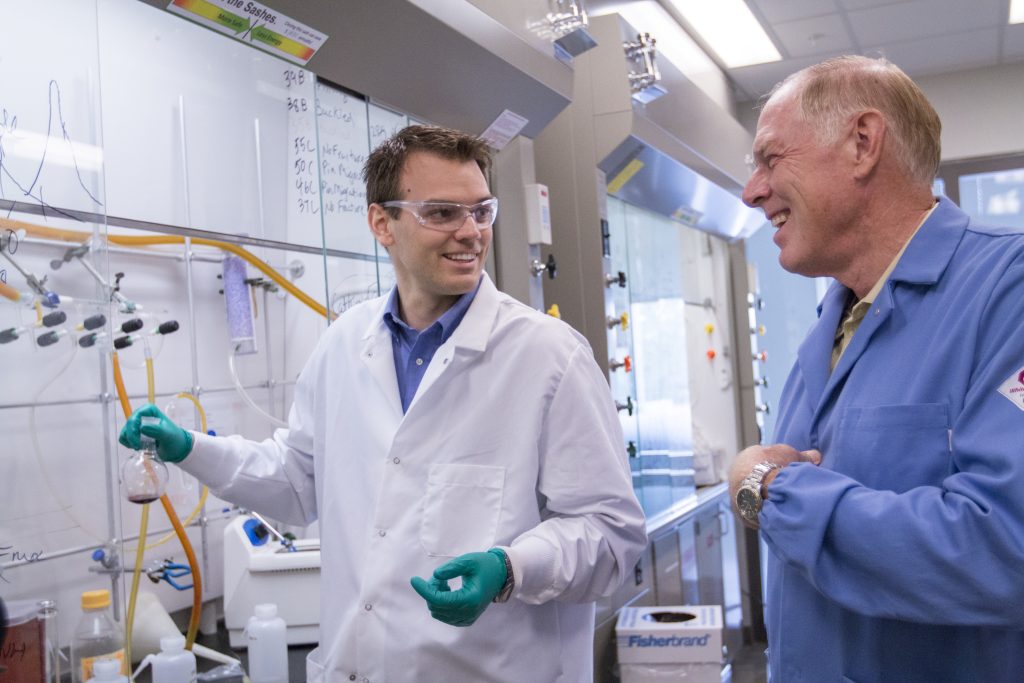
From autoimmune issues to cancers to fractured bones, Low’s Purdue-based lab is laser-focused on sharing this with the world through world-class research and appropriate commercial partnerships.
For Umoja, focusing on oncology and autoimmunity, two recent partnerships exemplify the process.
The first partnership with IASO Biotherapeutics, a biopharmaceutical company that discovers, develops, manufactures and markets innovative cell therapies and antibody products, gives exclusive access to Umoja’s receptor technology to develop two cell therapies. Umoja has exclusive rights to CAR cassettes to advance two other product candidates. This collaboration seeks to advance off-the-shelf cell and gene therapies with applications in oncology and immunology. Both will make treatment more effective and accessible to the wider public.
The second partnership is with AbbVie, a company that discovers and delivers innovative medicines and solutions that solve serious health issues. AbbVie has an exclusive option to license Umoja’s in-situ cell therapy candidates. The companies will also develop up to four other cell therapy candidates for targets selected by AbbVie.
The two partnerships reflect Low and Purdue’s long commitment to excellence and show the world what’s possible at the intersection of collaboration, passion and innovation in research and commercialization.